
Property Industry Eye published my first article on April 2 this year entitled Agents’ fees: Is this what you are earning?
I thought a follow-up might be useful, and maybe as a headline “How do you measure up” might be apt.
The information for this article is based on the invoices that My Home Move settles month-on-month. Over the year this will amount to well over 20,000 agent invoices, so it’s fair to say we have a significant sample to work from.
It includes transactions in every postcode.
However, it is only right to point out that it does not include many transactions in central London – but we all know that this market that has its own dynamics – nevertheless, it includes a significant amount of data from what we know as Greater London.
By the nature of their business model, we do not settle online or hybrid agents’ invoices, so you can conclude that these figures only include invoices from high street agents – big, small, corporate and independent. All figures exclude VAT.
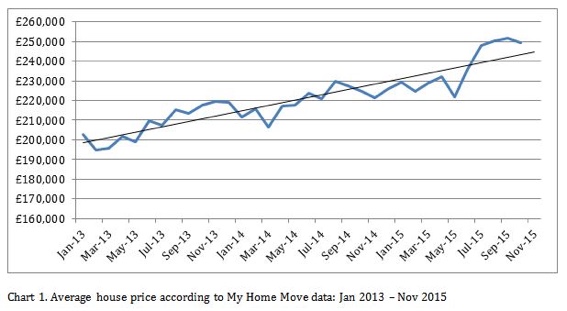
To put all of the figures into some form of context, My Home Move’s view of average house prices is shown in the chart below. It is based upon the house prices of all of those that we completed since the beginning of 2013.
In simple terms the average house price then was c. £200,000 and is now c. £250,000, which by the year end will be 25% growth in the past three years.
Chart 1. Average house price according to My Home Move data: Jan 2013–Nov 2015
The next chart shows the average fee that agents received over the same period which, if you follow the trend line, was slightly less than £2,900 in January 2013 and has now risen to c. £3,050 which is only 5% growth. So it is safe to conclude that fees have not increased at the same rate as house prices, because if they had the average fee would now be over £3,600!
Chart 2. Average fee received by estate agents based on My Home Move invoice data: Jan 2013–Nov 2015
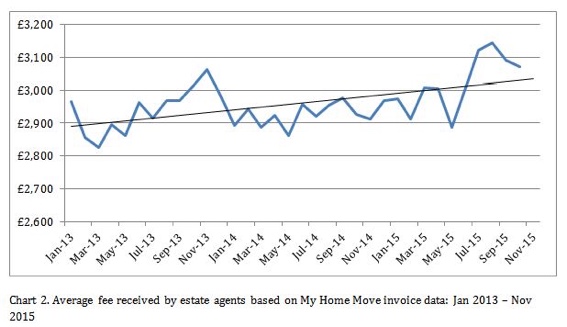
In this time, the fee has remained largely static and therefore, even in this age of low inflation, is worth less than it was.
I have also tested these conclusions with agents from all over the country, and whilst there are regional variations, the figure of +/- £3,000 seems to be about right.
Below is another chart that shows the movement in percentages charged year-on-year in bands.
Chart 3. Percentage charged by estate agents, year-on-year, 2014–2015
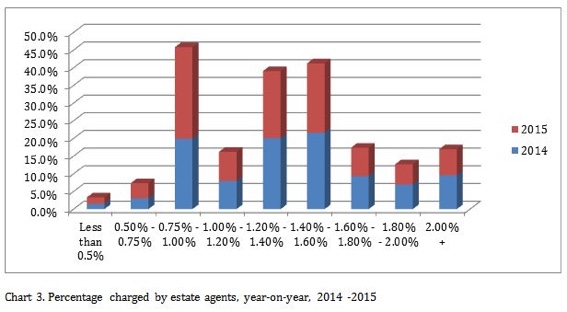
This, in general terms, illustrates the fall in the number of estate agent fees being charged at 1.2% or above, and the rise in the number of transactions that are charged below 1.2%. No surprise there I guess.
The biggest incremental growth year-on-year is without doubt the increase in the number of invoices between 0.5% and 0.75%, even outstripping the incremental growth of those charging between 0.75% and 1% which was the growing sweet spot that I highlighted in April.
In 2015 “less than 1%” now accounts for over 30% of all transactions, and over 1 in 16 are being done for less than 0.75%.
A transaction at the average house price of £249,578 at 0.5% is worth just £1,248, and at 0.75% is £1,871 – and don’t forget that this is on a ‘no move, no fee’ basis, so if you sell only 50% of your stock at this rate, you are earning only, in round numbers, £600 to £950.
I appreciate that the lack of stock has a significant influence on what is charged, and it is well reported just how little stock there is. But will agents’ fees rise as stock becomes more available? The evidence suggests otherwise.
Charging a % of the asking price, on top of which has to be added VAT, seems to be a cumbersome way of charging a client, and must surely get in the way of negotiating a fee when you need to.
A reduction in your fee of just 0.1% (at the average house price) including VAT is exactly £300, and surely this is too much to throw away each time?
So I guess the final question is, is it time to consider a new, transparent and easy to understand charging system?
And as I have not sold a house as an estate agent for well over 15 years, I look forward to hearing your answers.




Comments (64)
Interesting to see all these comments on an important subject but how PIE has decided not to run anything to do with the news that broke on EAT on Friday about how OTM are giving away membership free for over a year…
What’s to run?
EAT got moist ‘cos they had a ‘story’ that attracted three weeks’ worth of comments (24)… Messrs Shinerock and Mealham got sopping over each other… HarryN positively drowned without trace.
End of.
Hi again Smile Please!
Of course a lot of what you say is right and having the qualification is just another string to your bow. From Pee Bee’s response and others, it is interesting that whenever anybody brings up exam qualfications, it creates a lot of negative response. There is no logic in that because any additional knowledge learned from whatever source has to be of benefit in gaining instructions and negotiating sales. The NAEA has been promoting its qualifications more and a lot of young estate agents are taking up the courses and doing the exams (which are exams now Pee-Bee, not easy tests), but there’s still a long way to go.
Happy Christmas!
Mr Copus
I have no issue whatsoever with ‘qualifications’. Quite the reverse, in fact. I’m very proud of every one of my ‘O’ levels – even the Art one which quite frankly when looking back four decades I realise a chimp could have done a better job.
My own experiences of NAEA were as described. I joined firmly believing in the concept. I left knowing that the vast majority of Members – the great majority of those I am referring to ‘Fellows’ – paid less than lip service to the Association; turned up to approximately 0% of Branch meetings – and made up their CPD hours by claiming they read EAN and Negotiator for an hour a month.
I stand by the ACTUAL thrust of my previous post;
holding the TechAward or Dip doesn’t guarantee professionalism, honesty, integrity or dedication to the industry – just the ability of the holder to pass an exam set.
in exactly the same way that not everyone inside a Police Station can be guaranteed to be a Law Enforcement Officer.
Hello again Richard!
I think the negative response is for a number of reasons.
1. The public have no awareness of them
2. They mean very little. You can be a neg on your first day in the industry, go out and take a property on or you can have 30 years in the industry and go and take a house on the exam will make no difference.
3. They charge you for them. Its basically a revenue raiser for the NAEA which is why they push for mandatory regulation as they know they would be well placed.
4. Having a piece of paper saying you are a fellow really means squat, if you cannot build relationships and sell you are no good as an estate agent.
5. People hide behind them, there is almost an elitist attitude to people that have gain the in house NAEA or RIC’s estate agents qualifications. And they have no reason to feel like that.Just because they have passed an exam which is not recognised by the public and makes no difference to how well they can do their job they think they are better. They may have awful relationship skills, terrible negotiation skills, poor customer service skills, unorganised and unable to prioritise workload but hang on they have a piece of paper telling them they are a fellow within an organisation!!!
I know it is hard to hear the above if you have the qualifications (i do not know if you do or not Richard) but its the truth.
I resent young agents coming into the industry and many paying to join the NAEA and then paying to take exams when it really does not help them. I then resent established agent with the time and money basically taking the exam for status among there peers.
What i would be in favour of, instead of industry wide regulation (iwhich i do not agree with but thats a whole other argument) is a government issued test / exam that allows agents to value a property. Without it you cannot be instructed to value or sell a house. Almost like a basic surveying qualification. That for me holds a lots of reason and a lot promise for the industry.
smile please
You are, in the main, bang on the money.
In respect of a competence test, however, I feel inclined to disagree. NOT on the grounds that I don’t actually agree and wish it could be that way – but as I am the only ‘valuer’ in my town who actually knows the difference between a bargeboard and a ‘Bison’ beam, and I doubt lone example of such, such requirement would never be adopted by any Government as it would be deemed anti-competitive measures.
LOVE the idea, though… ;o)
I have agents round me that look puzzled when you mention a “Gable end” !
Obviously for many reasons this will not come into force, but even if it were i do not think they need a full surveying qualification just an exam that shows they know how to value and what effects value.
A simple example is leasehold properties, the amount of times an agent does not ask how long is on the lease or what the cost to extend before offering a market price is staggering!
But going back to the original thread, these are the type of qualifications i can get behind and endorse / support and i would even take myself and make my staff take.
I have no interest sitting an NAEA exam or my staff as they are just for vanity.
I am an FNAEA, I sat ISVA exams in Law, Town and Country planning, Valuation, Economics and Surveying. I consider that to be the minimum level of understanding to value property properly. Forget qualifications being required to sell property but have a mandatory level of qualification to advise on value.
Easements, rights of way, planning opportunities, supply and demand change of use, strategic consideration, there is more to valuing property than looking a number up on the internet and that is where the barrier to entry into the industry ought to be.
You know me too well Peebee, I can’t avoid answering a question directed at me.
It is fee erosion and it is caused by handing the ability to win instructions to people who ought to be doing something else with their time. The stuff I am now producing goes several stages beyond the detail in this story. Instead of wondering about new convoluted fee structures that vendors won’t comprehend and negotiators won’t be able to explain the industry needs to understand…. understand stuff that is apparent and obvious.
Robert May…
I see you made brief comment earlier today.
Not sure if you’re still reading this thread – but if you are and you can compose yourself from writhing in fits of ironic hysteria (…or is it hysterical irony…?) – isn’t this simply the ‘fee erosion’ that you have been previously hung, drawn & quartered for raising industry attention to over a period of several years?
Ahhh… nice to see the trusty ‘Disliker’ is back in town.
I was beginning to think you’d abandoned your duties…
Mr Hayter
I’m sorry – but Chart #3 makes no sense to me whatsoever.
Please explain. Someone in your organisation has obviously gone to great lengths to produce it for you so it would be a great shame not to capitalise on any relevance it may actually have.
Hi, I try not to do complicated, red is 2015, blue is 2014 – each block represents the % of invoices settled within each band. Hope that helps.
Well – I thought as much. The problems with that are firstly that the scale to the side makes it completely off-target; secondly it is extremely hard to compare YoY.
Should have been side-by-side for clarity.
Hi Smile Please. Agree about the public not having enough perception about the qualifications, but I often find they help me get instructions when I explain to prospective clients what the letters mean and what the exams entail. Sounds boring but it works for me.
I get that Richard, and agree when you are sat in front of a vendor it ‘could’ help.
BUT is the struggle in getting called out rather than winning instructions?
I would suggest it is. Even if you have “Fellow” after your name on a business card and a pretty stick in the window the public know nothing about it.
Heck even countrywide make their negs take a city & guilds qualification, what does that mean! does that inspire you with any confidence?
I agree with real qualifications the public recognise but not industry ones that mean very little. Where i could be persuaded was if the NAEA or RIC’s got off their backsides and actually promoted the qualifications to the public as opposed to the industry and explain how they are achieved and what it means.
I am actually really happy today as a number of stories today are starting to question the likes of NAEA. I have for a while been voicing my opinion as a lone person, looks like others are now willing to voice their opinion which will hopefully mean the NAEA take note and change or maybe another offer becomes available to full service property professional.
Mr Hayter – you say:
“So I guess the final question is, is it time to consider a new, transparent and easy to understand charging system?
Care to suggest one to promote lively debate?
This is a really important subject for agents so I have created a new topic on the ARENA sales forum, where the discussion can continue.
http://www.propertyindustryeye.com/forums/topic/alternative-fee-structures/
Fair to say that we are seeing the same in lettings as more and more estate agents enter the market with their cut-price deals!
A local corporate advertises full management at 12% on their website but regularly “does deals” at 5%. Where the accepted norm in town was always 10 – 12% ex vat it is now a struggle to get those fees as estate agents cut fees and fail to provide a good level of service.
I hear your pain but will be adding to it unfortuantley.
We have historically only dealt with sales but will be going into lettings next year. And we will be cutting fees for probably the first 12 months to buy market share.
Surprised and sorry to hear that, SP – I thought you would have been aiming to win market share, not buy it.
Its a no brainier for me to buy it unfortuantley,
I had three choices
1. Not offer it.
2. Offer it and have it as a side line and let it grow.
3. Offer it and throw everything at it to make it viable and profitable from the outset.
I decided on option 3, i did not want to play at it and see what happens so i have recruited a couple of really good experienced individuals and will be throwing money at it from day one so i get a quick return.
We will be looking to get 7% with competitive admin fees. Hopefully year 2 up to 12% with higher fees.
Definitely buy it sp, winning it as a new venture is so overrated!
Buy it and build on it, good luck too!
For an industry of expert negotiators and sales people there would appear to be a lack of negotiating and selling.
…………………………………………………….Amen
My average fee is climbing as we use data to show how much actual value we add. Why would you choose to sell with a major national who has an average sale time of half a year, sells less than 50% of what they take on and, for 12% below the original asking price when you can sell with an agent who achieves a sale in half that time with a >75% success ratio and, at >96% of the original asking price?
From percentage chance of selling to average selling times and average price achieved, we wipe the floor with the majority of our competition and our customers are financially better off as a result. Every good agent can and should be using data to achieve better fees and drive out the cheap cowboys.
Sites such as getagent.co.uk are starting to pop up and will become the norm as they are in the USA; giving customers access to independent data. Independent, free sites using the same data will also spring up to compete. Poor, average or lazy agents will have no-where to hide along with those on-line agents who make wildly misleading claims that breach the law.
As a branch manager I sat down with a business owner a few years ago and calculated based on the historical data of the office that £x fee was the minimum fee that could be charged to allow the business to profit, so as long as every instruction was saleable and above minimum fee, happy days! It made things simple, overpriced-walk away, fee too low-walk away and left time to concentrate on creating other business that enabled the business to be sustainable whilst the message was clear to customers, we charged, but we Sold.
The reason why fees are dropping is that there are too many agents.
Any market that becomes saturated with traders selling the same product or service suffers exactly the same downturn in prices and profit.
Cost of entry into estate agency has fallen relative to what it was during the height of the high street. Empty shops mean deals can be done on rents and lease periods, the internet is allowing local agents to operate in large areas from one office and OEA’s from a serviced office or whatever.
With OEA’s like PB advertising low fees heavily on TV, and more and more hybrids advertising low fixed fees locally, it is inevitable that sellers will be increasingly influenced to challenge established agents on their fees.
Going forward, the really successful agents will in my opinion be either low fee, high volume or niche market high fee, low volume. Those who attempt to stay where they are and keep their current mentality, marketing and fee structures will be the ones most at risk.
Absolutely nothing ever stays the same, and that includes estate agency.
These graphs show that a lot of agents are working in fear.
Managers/Owners of those agents charging such low fees lack the required ability to hold such positions; the ability to create an ethos that reflects all the good things that we should be doing and then getting the staff to buy into it. Where is the leadership I ask.
As a business, success is not measured by instruction levels, viewings, offers, sales. It is profit. I bet those agents charging twice as much provide a better service and make more profit. The managers/owners know what they want, how to get it and ooze confidence. As a person in that business, success is measured by the value the customers put on you; their faith in your ability to achieve their goal cannot be cheapened by a low fee.
I agree with everything you say in principle peter, however the reality of estate agency today is not so easy. I work in town of circa 7500 chimney pots and there are 11 agents! I was invited out to a property recently whereby the vendor had had two valuations already from “reputable” agents” who both quoted .85%. tell me, would you really try and sell your services at 1.5%? I can tell you what the result would be. I spent 10 years working for CW and I applaud HH’s ethos but its just not viable today as there is not enough stock/opportunity for me to ‘take it or leave it’.
“tell me, would you really try and sell your services at 1.5%?”
No, more. Not trying to be flippant, but are you really saying the skill sets are not there to counter low fees? As soon as you give in and match, it becomes easier next time and the next time, then what, .5%. Value is not the cheapest.
Ask yourself – Do you want to ride a bike uphill or downhill!
Personally I’d much rather take a taxi…
…which of course you can afford to do if you charge decent fees for your services. ;o)
all very training room-esque peter.
as stated before, I wholeheartedly agree with the sentiment. Having been in this industry for close to 20 years, I do not doubt my skill sets or my pride in the service I can offer. buts lets have a reality check here, if you came into my town and tried to justify fees of higher than 1.5% then you would go out of business. I have a mixture of strong long standing agents and the usual corporates and we are all racing to the bottom. The problem here is that .85% mentioned earlier still represents over 3k fee.
and just to be clear, I don’t advocate low fees. I believe the fee we charge is well worth it and hate the fact that as an industry the average fee is dropping like a stone. personally, I am doing all I can to keep our fee as high as possible. The point I am trying to make is that its not just one or two cheap fee agents in town any more, its the majority.
I think the stats reflect the world we live in nowadays. Especially when we compare with ‘the good ole days’, we can see what is essentially a better product/service for a lower price.
Look at every area of the market and we are being charged proportionately less for proportionately better commodities. iPods, TVs, Estate Agencies, baked beans – they all get slightly better and slightly cheaper over time.
Forgive me if I’m wrong, but these figures are reassuring – it means that estate agents are able to respond to general consumer behaviours (demand more for a lower price) without running themselves into bankruptcy.
However, as always, I’m willing to be shown why I’m wrong.
Perhaps it’s time to flip the whole thing on it’s head and start charging buyers rather than sellers. Vendors will then instruct the agent they genuinely feel is best for them, without having their judgement clouded by the low fee brigade. It will remove the entire online sector in one fell swoop and bring the business back to being service focussed, rather fee focussed.
Yes, I know it’s controversial and we would all be hammered for raising the costs of entry for FTB’s, but recently in my area numerous agents ran with a “For Sale by Tender” approach which meant that buyers paid the fee (very often 2%) and nobody died.
Just a thought….
“rather than fee focussed”
Well said Agency Negotiation Limited. Estate agents rarely acknowledge their self-worth. Free “probate” and “matrimonial” valuations to such an extent that solicitors milk the fact that many agents do them for free. Far too much emphasis on fees rather than service when carrying our valuations/presentations. The whole ethos is lowest common denominator rather than highest common factor.
Now is the time to develop specialist departments. 99% of online agents are not interested spending time learning about listed buildings and period properties. Auctions are growing in popularity as a method of selling everything from jewellery to land. Using one’s personality and local knowledge and the fact that we can speak to people face to face from a high street office. All these have to be the way forward.
And dare I bring up the old chestnut of qualifications?! The higher up the market you go, the more professional expertise becomes important to clients, and professional qualiification by examination, whether NAEA or RICS, shows that you have made the effort and are a dedicated professional, whatever some agents would like to think!
In regards to qualifications if they hold a surveying or possibly even a degree i can see relevance as the public are aware of them and recognise them.
In respect to NAEA or RIC’s estate agent qualifications i truly believe the hold no water, the public are not aware of them they are not well publicised. You may as well have your own in house qualifications you can talk about on valuations.
But i do agree wholeheartedly with your first 2 paragraphs.
“…professional qualiification by examination, whether NAEA or RICS, shows that you have made the effort and are a dedicated professional, whatever some agents would like to think!”
What about the UN”qualified by examination” NAEA Members/Fellows, Mr Copus? Those that got in by handshake or the old Interview route? Or the 20 question ‘Test’ that I aced in seven minutes because I knew how many legs a three-legged donkey had – but was offered help if I got stuck?
Hi Pee Bee. You must be older than me! There are fewer and fewer of them left, about 10% of members at the last count. I think you’ll find the Technical Award is more than just a 7 minute test! And of course there’s the Diploma.
It was a 30 minute test (mid/late90s) if I remember correctly, Mr Copus – that’s the point!
The seven minutes I quoted included being told I’d finished too quickly so I should check my answers…
And I’m afraid to say that holding the TechAward or Dip doesn’t guarantee professionalism, honesty, integrity or dedication to the industry – just the ability of the holder to pass an exam set.
Interesting comments above.
I think its all a little simpler.
We have great appetite from buyers. We have very little stock.
Agents are trying to win business by cutting their fees as opposed to selling service.
In the past agents would maybe top the price in a market like this but now every agent is doing it as every property is selling (well nearly every property).
We are cutting our own throats.
BUT agents will disappear as their turnover will fall, and also the market will (at some point) correct itself which means will will find a more natural average fee as opposed to look to undercut every agent on every val.
The plus side is as the average price has grown so has the commission if you stick to your fee, For instance we have less sales this year but record turnover
what you say er! sort of works.
But
Leaders E/A are buying up independents that have a strong letting business as they recognise good customer service can maintain a viable business.
Sales agents (wot like I am) are being squeezed by on line: low fee-no service and high street agents over pricing.
Fortunately I work with a pretty good bunch with a strong lettings portfolio and loyal client base too, but that doesn’t stop our market being squeezed to the point where you have to ask yourself where will it all end up.
This is why I often mention alternative business models ( and why I don’t think there is any disruptive technology out there yet that will change our game) that might be our future whether we like it or not.
And again for example:
A letting agent offering targeted free sales service to generate more landlords, if a property looks like it should generate 5% + revenue why not offer to sell it gratis?
A financial services or conveyance business offering free sales to generate more mortgages or legal work?
Whilst these ideas seem to be stretching our imagination it’s not so far away with optional extras: pay more to be seen on RM, pay more if you want accompanied viewings, so forth and so on.
if the model is scalable, someone will try it, it’s just a matter of time. However if it becomes a free service how would NAEA or other professional bodies influence or police it? Would the home seller become vulnerable if they are not the actual client?
So the pie is getting smaller with more and more agents enter the market, high street or on line.
House prices are not looking to increase much with London looking very over priced.
Therefore a vendor looking to move will squeeze every penny to make the deal work.
If I was 20 years old (which I am definitely not) would I want a career in estate agency? Would there be enough in it to make a decent living?
Uur intern this summer is so excited by the futuristic stuff he has been helping with he is desperate to be an Agent!
There is very little that I would commend about the ‘corporate’ approach to estate agency but Harry Hill highlights a very strong point in their favour. When HQ says ‘this is our fee and it is non-negotiable’ the valuers and negs have nowhere to go but to win the business at that fee level or suffer the consequences.
Sad, very sad indeed to acknowledge that many in this industry have little or no self-worth. The hours of time and effort that go into creating brand awareness, gaining an instruction, promotion, negotiation, and progression seem to be of little worth in the eyes of some agencies and consequently in the perception of much of the public.
Is there an answer to this race to the bottom? In my view, it requires differentiation through personality rather than brand and, the ability to create affinity with niche sectors of the public. Too many agencies attempt to be everything to everybody for commercial reasons and fail to recognise what makes them unique. Create a culture where potential vendors can be inspired and will become evangelists for your agency, rather than a sales culture that can only manipulate on price. Low prices only make agencies weaker and the sector,as a whole, less reliable.
Estate agencies are right up there with bankers and politicians as the most mistrusted of professions and, in many cases, the reputation is well justified.
REDUCE YOUR AGENCY FEES
words from your website…….???
Let me be clear, Agent Orange. Our primary goal is to achieve more for the vendor and in most cases this would involve the agency getting a higher fee. Where the agency has been unable to achieve the asking price, a performance related fee would save the vendor money (based on the original fee structure) and the agency, of course, would receive a lower fee. Our claim to save vendors money is therefore still valid in the instances where the agency fails to achieve, but I suspect that you imagine our goal is simply to have agencies earn less commission. Let me dissuade you from that notion. I am more than happy for any agency to earn more commission that results from their having done a better job. I view a sliding scale fee as far more productive than fixed percentage. Apologies if our web site has led you to this imagined contradiction.
Mr ‘agency blah, blah, etc’
Let ME be absolutely clear. ‘agent orange’ has come to no “imagined contradiction”.
Your website is FULL to the gunnels of references to vendors savings on Estate Agency Fees.
Your business charges are based upon savings made.
You have a section on your Homepage entitled REDUCE YOUR AGENCY FEES.
You need a serious reality check.
Pee Bee, your contribution is, as always, much valued. Nevertheless, I adhere to the beliefs already expressed. I have no problem with any estate agency, for example, offering significant “black Friday” discounts. It is, after all, a manipulative sales tactic designed to increase sales for an agency that perhaps has run out of ideas to generate a loyal client base. In that instance, a vendor would have no need of our services to save money. All they would require is for us to warn against using such an agency that obviously can only use fee reduction to generate interest. If on the other hand, an agency was confident in both its valuation and its fees, yet the vendor had little understanding of the implications of the fixed % fee structure, our services are designed to assist the vendor in arriving at a logical conclusion.
Our business model, as you rightly say, is based on savings made for the vendor. This is not predicated on any agency earning less by achieving more for the vendor, but may be a reflection of the agency inability to live up to its promises.
Stephen’s post highlighted the trend in agency fees and questions whether there may be a simpler fee structure and I responded by suggesting a sales culture was not in the best interests of the industry. Agent Orange took it upon himself to use this as an opportunity to again question the validity of our services. Right on cue, Batman rides to Robin’s rescue.
Thankfully, we are not attempting to win over every agency to our services, just the better ones. And, again not every vendor will require our services. But, thats OK. It’s called niche marketing.
“Thankfully, we are not attempting to win over every agency to our services, just the better ones.”
“Better” in whose opinion, Sir?
“Better” in what way, precisely?
Specify your criteria for “better”.
To me, it seems you mean the ones that capitulate and dance to your tune.
I ain’t ever going to dance for you. That, I take it, makes me an inferior Agent in your eyes.
That’s fine. You’re entitled to an opinion.
It’s anyone that chooses to use your services in my neck of the woods that will lose out as a result of your opinion…
…not me.
As you say, its my opinion and since we agree to disagree on pretty much every issue, we’re done. There is little point in wasting time on people with whom one has no affinity.
“There is little point in wasting time on people with whom one has no affinity.”
Which, from what I’ve witnessed so far, seems to equate to the entire EYE readership.
As far as there being little point in wasting said precious time of yours on me in particular, Mr agency etc I would suggest the opposite be the case.
It’s called learning to win over objectors – and believe me, you need all the practice you can possibly get in that direction.
And therein lies YOUR problem, PeeBee. Objection handling is firmly embedded in a sales culture and is one of many reasons that vendors mistrust some estate agents. People don’t like being sold to. The sooner some agencies understand that the better.
Just as an aside, I see a few more likes than dislikes on my previous posts and one very nice comment from Richard Could, so possibly not the entire Eye readership.
You misread or misquote me – I presume purposefully in an attempt to have yet another negative swipe against Agents. I said learning to win over objectors – NOT “objection handling”. There’s a massive chasm between the two that you will clearly never traverse.
As far as the second point – I’m sure your view of the situation sits far more comfortably with you than mine does or ever will.
Enjoy the view.
Learning to win over objectors! Since the culture of your estate agency is presumably derived from your management and is fundamentally at odds with ours, whether you object to our business model or not, our time is better spent on association with like-minded individuals rather than endless debate that serves no meaningful purpose other than to further entrench each others position (and amuse).
We have relationships with agencies that are open, honest, diligent, forward-thinking and possess an abundance of integrity. Those are the agencies that we wish to work with. We are not in business to make ‘swipes’ at agencies – that is a generalisation and unfounded. We are all for agencies earning much higher fees providing they can justify them and have something different to offer. Our allegiance is to the vendor but that does not prevent a meaningful business relationship with any agency.
This exchange has moved away from its original post by Stephen and as I mentioned earlier, we obviously agree to disagree.
“We are not in business to make ‘swipes’ at agencies – that is a generalisation and unfounded.”
And here we are – right back at the very start of this exchange, where ‘agent orange’ quoted direct from your website… “Estate agencies are right up there with bankers and politicians as the most mistrusted of professions and, in many cases, the reputation is well justified.”
That little nugget kinda bu99ers up the claim above, dunnit?
Pee Bee, you and your dear friend AO can take quotes out of context from our web site and use them to propagate the myth that we have little respect for agencies,in general. Were that the case, we would not be interviewing established estate agencies such as Knight Frank on our web site and praising other agencies that really have the interests of the vendor,at heart.
Just so you are able to follow our reasoning, Reduce Your Agency Fees, as a heading on our web site, explains to vendors that if the agency does not achieve on its promises, there can be a saving based on an alternate fee structure. I think that might have been the point Richard was making when he suggested an alternate charging system.. .
You both obviously take exception to our business model and web site content, as is your prerogative. We stand by it and are here primarily for vendors to explain why some agencies do a poor job. I trust you do accept that there are some out there, or would you rather we not mention that fact?.
I think I detect the onset of The Dunning-Kruger effect with your posts and perhaps your continual skulking around in a cloak of secrecy is one of the contributing factors. Should this early diagnosis be eventually confirmed, I take no pleasure in being the first to notice.
I love it when it starts to get down to this level!
Tell me, how often does your superbly demonstrated tactic – ‘If you haven’t got the necessary skillset to win… call the judgement of your opponent into question under medical grounds’ – actually result in you retaining a client?
Or do they simply smell the coffee and enlist the services of the Agent that you were unable to take more than £250 from?
Something good has come from all of this. It’s taken a while – but we got there in the end.
As a result of this most recent exchange, I’m now sure there is a place for you in the market.
Just not THIS market – but I established that a while ago, in fairness.
My advice would be to set up a self-diagnostic website for those showing symptoms of cognitive bias disorders – you seem perfectly qualified in that respect. Takes one to know one and all that…
And don’t worry – this isn’t an attempt at getting the last word. Whatever disorder that particular compulsion comes under (I’m not asking for an answer to that as I’m sure you will be able to diagnose several…), I’m fully aware that you have a double dose of it, so, here is the last word – just for you:
zyzzyva.
Very interesting Stephen.
As public information will show, during my 20 year stay at Cwd, our average fee never dropped below 1.8% across the UK, despite the average being depressed by the much lower fee that prevailed in the NW.
Sadly, in the last 5 years all agents appear to have entered into a race to the bottom, and as your figures show, it seems possible almost everywhere outside Central London to get “traditional” agents, some of whom are by no means useless, to quote fees well under 1%.
My only conclusion from that is that either:
1. The agency industry has become hugely more efficient and is able to generate greater percentage net profits from turnover than my (I think very high class team at Cwd) were able to produce. Or
2 Agencies are in fact making very much reduced profits. Or
3 Many agencies (like Cwd) have accepted that the “good days” in house agency are long gone, and are wisely (in my humble opinion) seeking to grow even further their lettings portfolios, with the profits from that side of the business effectively subsidising sales.
Personally, I find it sad for whilst I am obviously no longer at the sharp end, did spend 35 years “in the field” listing and selling homes in towns and Cities where there were always some cut price fee operators, but had little difficulty in maintaining good (circa 2% fee levels) and market leadership.
The advent of on-line agents (goodness knows how any of them will ever make a profit) will no doubt accelerate the race to the bottom for many.
Good luck to them!
Harry Hill you may have got 1.8% but your stock levels are very low. For the biggest UK agent others run rings around your poor service levels and short term business plans. Selling EPCs to pensioners who already have one is the tip of the iceberg!
I do love it when the good old boys (messrs Smith/Hill) get on here and talk about how well they performed back in the day. I’d love to see one of these guys start an agency today without crowdfunding or investment or a brand.
Fair play for riding the property and dot com boom gravy train to the top and all that, but its a very different playground now.
As for the ”high class team at Cwd” and average fee’s of 1.8%, I was there for 10 years and have no idea what your talking about.