
The media bashing that high street agents are currently getting has exercised a lot of minds in the industry, but this – from Ed Mead, of Douglas & Gordon in London – could chime with your thoughts.
Here, in a new blog, is what he says. In a nutshell, human beings buying, selling, letting and renting homes need the human touch, and the internet is over-selling itself. It’s a tool, nothing more.
Do you agree?
Mead writes:
“Buying, selling, renting and letting is not a two-dimensional experience.
Comparisons between online and full service agents are missing the point. The limitations of what the internet can and can’t do surely make the argument for us.
We should all welcome competition, and given the way the world moves we might all be expected to move with it. Except for one thing: what we sell isn’t a commodity bought on price and it hasn’t changed for thousands of years.
Buyers set parameters, often wrongly, but buy on emotion, and emotion isn’t conveyed in pictures, however cleverly delivered.
My concern for the business of buying and selling property is that the internet services the needs for buyers and sellers to a point, BUT as a medium is over-selling itself in the whole process.
If we were all living like battery hens, then it might be a different story, but luckily human beings require a human touch.
Let me use an example. When I started, photos on details were a rarity and floor plans a distant dream. As for area, you’d have an idea where you wanted to be but were a little bit flexible.
Anyone calling an estate agent (probably with budget of £25k back then!) would be invited in and would spend an afternoon looking at what they thought they wanted and end up buying what they needed. The latter would very often be miles away, metaphorically and geographically, from what they started off looking for and would be because they’d taken the time to look around.
Modern day searchers will go onto a big portal and simply put in a list of their priorities and wait for their inbox to fill up. This has two corollaries: one, that they will usually only see what they think they want, not what they really need; and two, that the agents simply become key-holders and lose the ability to actually advise people.
Everyone seems to see looking for property on huge monolithic portals as a universal panacea, but with up to 40% of properties (in my experience) selling without seeing it on the web, this is obviously not the cure-all we may think.
Finding the right property is all about knowing the locality you want to live in and having someone there unearth the right thing for you.
This has always been, and will for quite some time, I think, be the preserve of estate agents. A good one will open up a real new world to consumers, not one limited to a computer screen or mobile device.
Online agents are welcome to some of the action. A central office with a dozen agents looking after the whole country may provide a ‘cheaper’ service – although perhaps £500 upfront versus an average fee of £2,500 IF sold is not the bargain it appears – but it can never replace the local knowledge that the huge majority agents use to both their buyers’ and sellers’ advantage every day.
The internet is a tool designed to help humans. Buying a property is an emotional process, and until the internet can communicate that, consumers write off full service local knowledge estate agency at their peril.”
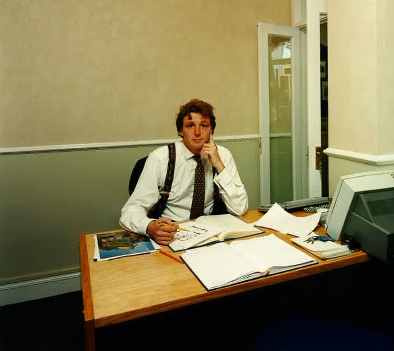
Pictured is a young Ed Mead starting out in estate agency – with the internet a distant prospect and the office décor distinctly underwhelming.
Editor’s note: If you have strong opinions and/or run blogs on your website that you think may be of interest to the industry as much as to consumers, please get in touch with Eye.
Email: ros@propertyindustryeye.com
Comments (8)
We are all online agents now…….. the non high street ones are often failed agents and the only way they can secure business is by dropping their pants/fees. The rest of us will still dominate if we offer 'virtual' and 'high street' options. We looked at 'upstairs' offices a while back – they weren't much cheaper to rent than ground floor retail units and the only saving is displays which costs a couple of grand. If they are doing it properly an internet only agent wont be that much cheaper to run than high street premises. Someone working out of a spare bedroom isn't going to attract the majority; likewise I am not selling my house in Surrey through a call centre in the Midlands!
Buying and selling is the most expensive transaction for most people in their lifetime. Why would you not ask an expert who watches the market daily to hold your hand? I can see lettings being more effected by the internet as it's a glorified hotel booking experience and one day technology should be able to do most of those things. The subject of correct valuation can not be addressed by technology though. How will the internet know that! Demand can have an effect on prices on a quarterly basis (quicker than land registry updates!). Is it really a bargain saving a few thousand pounds to get 10 times less in your selling price. What makes more sense is to regulate agents and move towards the US model where qualified agents handle most of the transaction process within their fee.
Ed, you echo what I've been saying for a long time! I have a member of staff who is worried by 'online estate agency'. I'm not ignoring it but have said to her that she should concentrate on providing the correct levels of service in the way we always have. Not everyone will see it our way but then not everyone will 'buy' the alternative and it's more about trust than anything else. It's hard to look someone in the eye over the web!
'Modern day searchers will go onto a big portal and simply put in a list of their priorities and wait for their inbox to fill up. This has two corollaries: one, that they will usually only see what they think they want, not what they really need; and two, that the agents simply become key-holders and lose the ability to actually advise people.'
We all know the expression 'buyers are liars' and we've all seen buyers eventually buy something totally different to what they first described to us, but I'm a little concerned by the implication that we know better than buyers what sort of property they want.
Hi Hound ;o)
"I'm a little concerned by the implication that we know better than buyers what sort of property they want."
I see where you are coming from in this respect – but as Mr Mead has said – t'interweb is two-dimensional so even his comments appear flat and you read into them what you want to (or I should say what you see).
I'll bet that you wish (as I do…) that you had a quid for every time you 'sold' a buyer a home that they hadn't started out looking for.
And, mon ami, t'interweb simply processes what you input, and will NEVER be able to cater for the human element of head:heart.
Only YOU can do that.
Morning PeeBee, pleased to see you're still here, you've been a bit quiet lately! (although I see you've been playing on the dark side) 🙂
Agents that have the view that you can 'sell' someone a house have always concerned me. I've always seen my role as guiding people towards homes that may suit their needs, and helping them with that decision, and then being certain that they have made a decision that they are totally comfortable with.
I've seen it time and time again where the corporate boys have 'bullied' someone into making an offer, only for them to withdraw a few days later. Again, we've all heard the expression 'Buyers remorse' Buying is indeed an emotive decision, but with our protracted methods, there is time for people to think again.
And of course, the initial contact has, broadly speaking, always been two dimensional, be it a picture in our window, a set of details mailed out, or a newspaper ad, or, nowadays, the interweb, but once the initial contact is made, our work begins to help them find their ideal home and encourage them to get out and view.
It's in the listing process that we need to be good salesmen, rather than the buying. I've always thought that you can tell a good agent by their answer to a simple question 'What does an estate agent do' ask that question to a neg sitting in a corporate office, and they'll probably give you a puzzled look, and respond that 'an estate agent sells houses' My answer would be that 'an estate agent sells a service to someone that wants to sell their house'
Couldn't agree more. The amount of stories i can relay about what my buyers registered for and what they actually bought, could fill a book. Having been in agency for 26 years and running my own business for 20 of them, the required skill set has't changed at all.
Bucket shop agency has been around for a long long time and does have a market. But i truly believe that, regardless of what you do, if you offer a truly honest and genuine service and are fair with what you charge, you will survive most things that get thrown at you.
Someone with a bit of passion and a fire in their belly about our industry and the service we provide…Quite right!